Privacy-Preserving Optics for Enhancing Protection in Face De-identification
We design the camera lens itself to perform face de-identification, so the real face never leaves the camera.
¹ Universidad Industrial de Santander² KAUST* Project lead · † Equal PI contribution
What the camera sees, and what leaves it
Pick a person and a reference face. Every image below is a real output of our trained model on CelebA-HQ test faces, nothing is simulated in the browser.
The lens is optimized end-to-end so the capture keeps enough structure to locate the face, but not enough to recognize who it is. The reference only sets the style of the new face.
Privacy at the hardware level
Software face de-identification gives a good privacy/utility trade-off, but the original image still exists before it is processed, so anyone who intercepts the stream sees the real face. We move protection into the optics: the camera itself captures an image that hides identity, and a network then generates a new face from it.
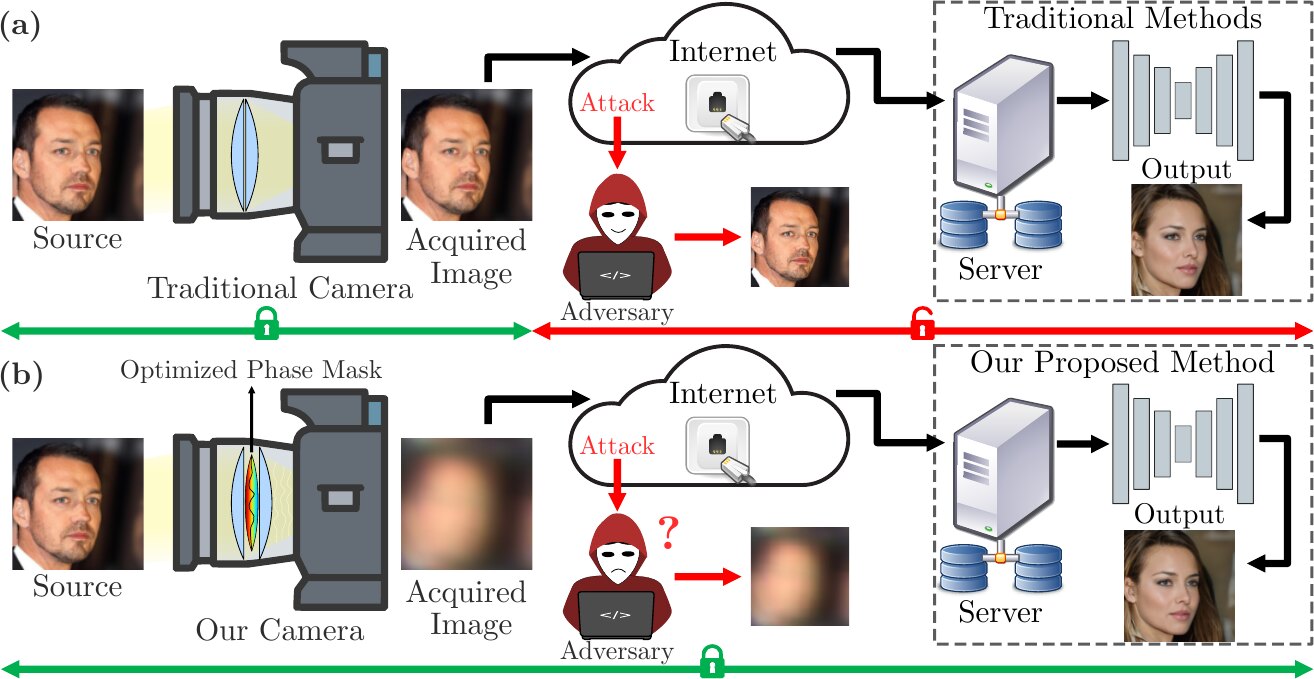
Learned optics + anonymization
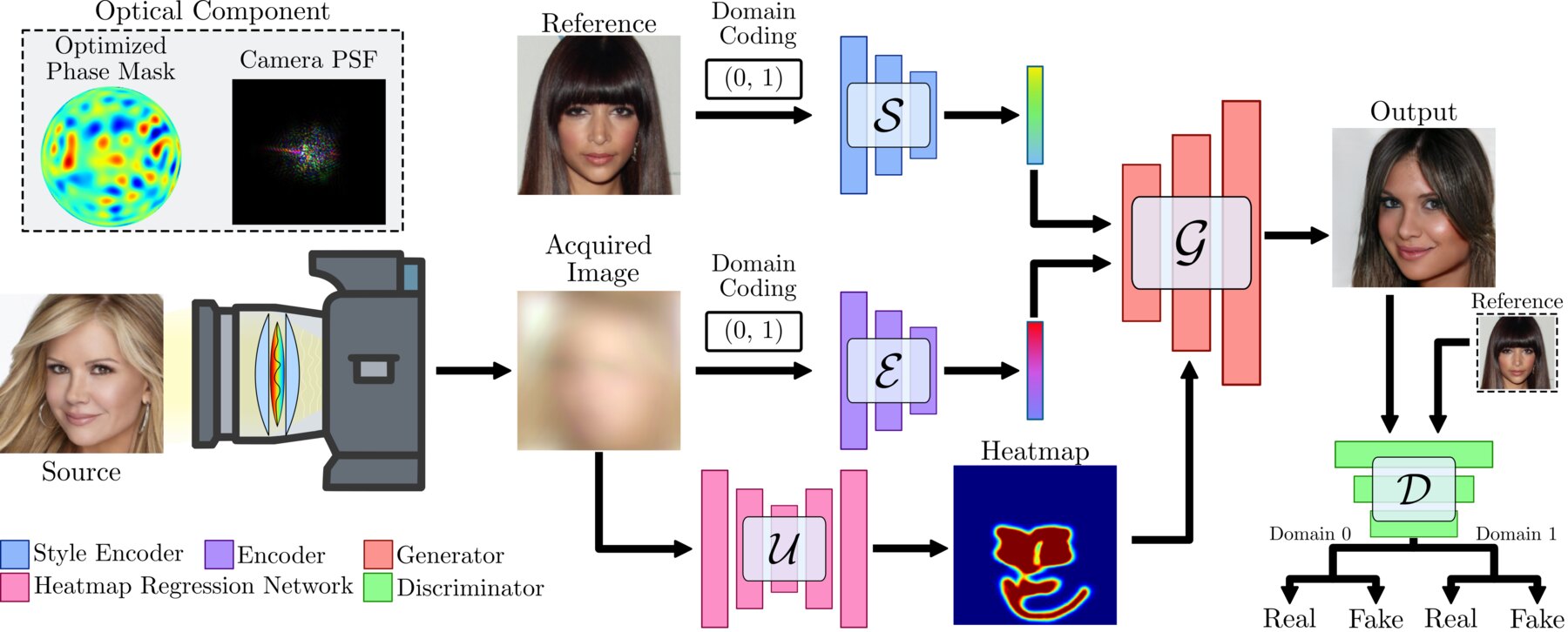
Optical encoder
A phase mask in the lens, parameterized with Zernike polynomials, shapes the camera PSF so the captured face is blurred beyond recognition.
Heatmap regression
Trained jointly with the optics, a network recovers a face heatmap from the protected capture: where the face and its parts are, not who it is.
Anonymization
A GAN uses the capture, the heatmap and a reference face from a public dataset to generate a new, realistic identity with the same pose.
Better faces than a low-resolution camera
We compare against a low-resolution camera, a common hardware-level privacy baseline. Our lens gives more realistic faces (lower FID) and keeps the face geometry closer to the original (lower bounding-box and landmark distances).
| Camera | FID ↓ | FD (MtCNN) ↑ | BB (MtCNN) ↓ | LM (MtCNN) ↓ | FD (Dlib) ↑ | BB (Dlib) ↓ | LM (Dlib) ↓ |
|---|---|---|---|---|---|---|---|
| Low resolution | 34.161 | 1.000 | 5.358 | 2.392 | 0.994 | 4.694 | 2.749 |
| Privacy lens (ours) | 29.218 | 1.000 | 3.314 | 2.298 | 0.991 | 4.821 | 2.716 |
FD: face detection rate on the de-identified faces. BB / LM: bounding-box and landmark distance between original and de-identified faces. Numbers from the official repository.
Video overview
BibTeX
@InProceedings{Lopez_2024_CVPR,
  author    = {Lopez, Jhon and Hinojosa, Carlos and Arguello, Henry and Ghanem, Bernard},
  title     = {Privacy-Preserving Optics for Enhancing Protection in Face De-Identification},
  booktitle = {Proceedings of the IEEE/CVF Conference on Computer Vision and Pattern Recognition (CVPR)},
  month     = {June},
  year      = {2024},
  pages     = {12120-12129}
}